Lead ME
Hextronics
I’m the lead mechanical engineer on Eclipse, our drone-in-a-box. I own the design of the Helios drone and the Luna dock it lands in and charges from.
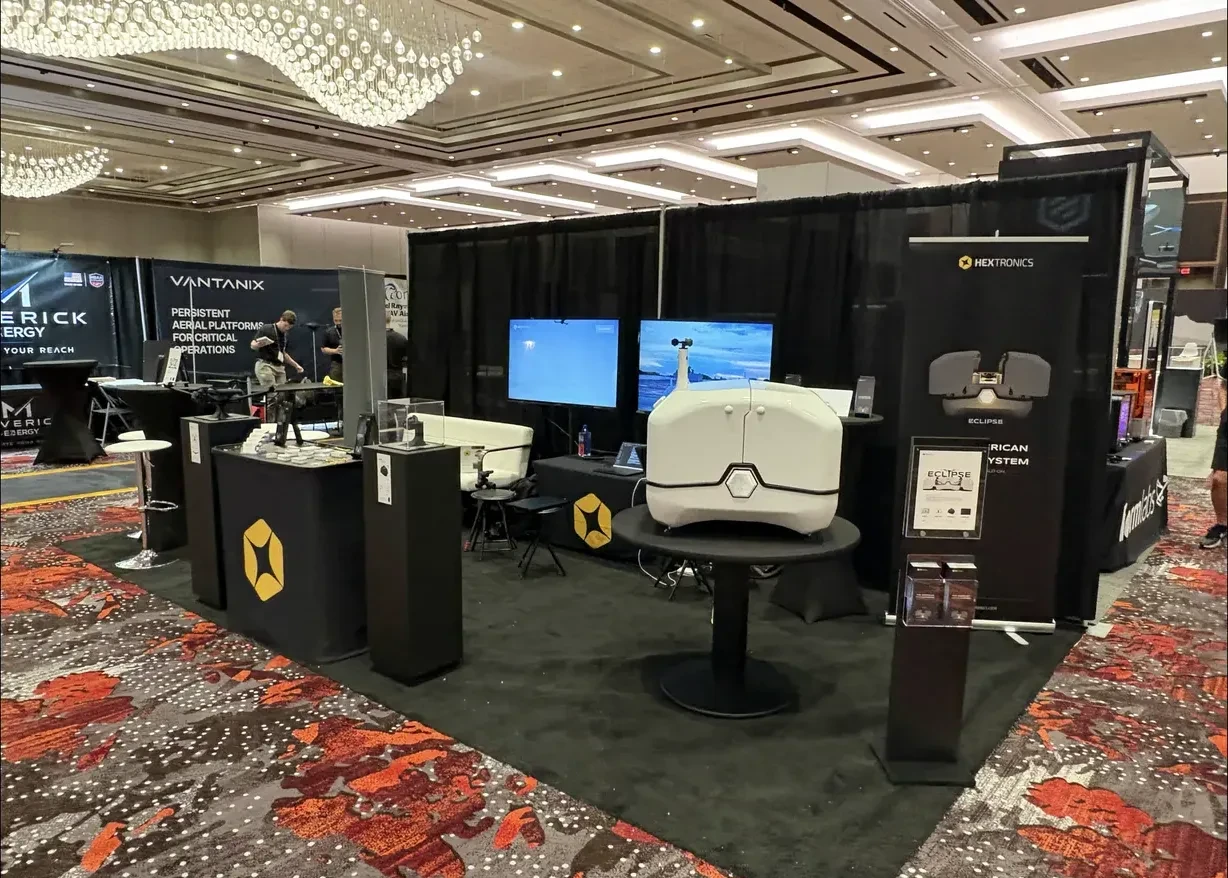
Helios takes off from the Luna dock, flies its mission, and then lands back in the dock to charge. Nobody has to be there. I took it from the first concept to the public launch at CUAV with a team of six. Besides the mechanical side, I spend a lot of my time on systems engineering, RF and keeping the project on track.
We filed patents on the design, and it’s patent pending.
What I’m most proud of
Simplicity: only two actuators. I put the charging arms on the same mechanism that opens and closes the roof. One move closes the roof, centers the drone to a tighter tolerance, connects the charging arms and locks the drone in place. That got rid of a whole set of actuators and parts, plus the wiring and the failure points that come with them.
Passive centering. Other docks use actuators and sensors to center the drone. We do it with gravity and geometry. The dock and the drone are shaped to fit each other, so when Helios lands it slides into place on its own.
Contact charging. There’s no plug to line up. The charging arms come in as the roof closes and press onto the contacts on the drone, so Helios starts charging the moment it’s locked in. The hard part was making it connect every single time on a drone that never lands in exactly the same spot, and that’s where the centering and the charging mechanism work together.
Thermal management. Eclipse has to work anywhere, from Arizona summers to Canadian winters, so we have to both cool and heat the drone and the battery. In the heat, cooling is what lets us charge as fast as possible and get Helios back in the air. In the cold, heating keeps the battery ready to charge and fly.
Industrial design. I also did the industrial design of Helios. I wanted it to look like a finished product and not a prototype, clean and simple on the outside, with everything packed in tight underneath.
On the analysis side, I built the flight performance model for Helios, going from the motor and prop data all the way to flight time, and it matched what we saw in flight testing.